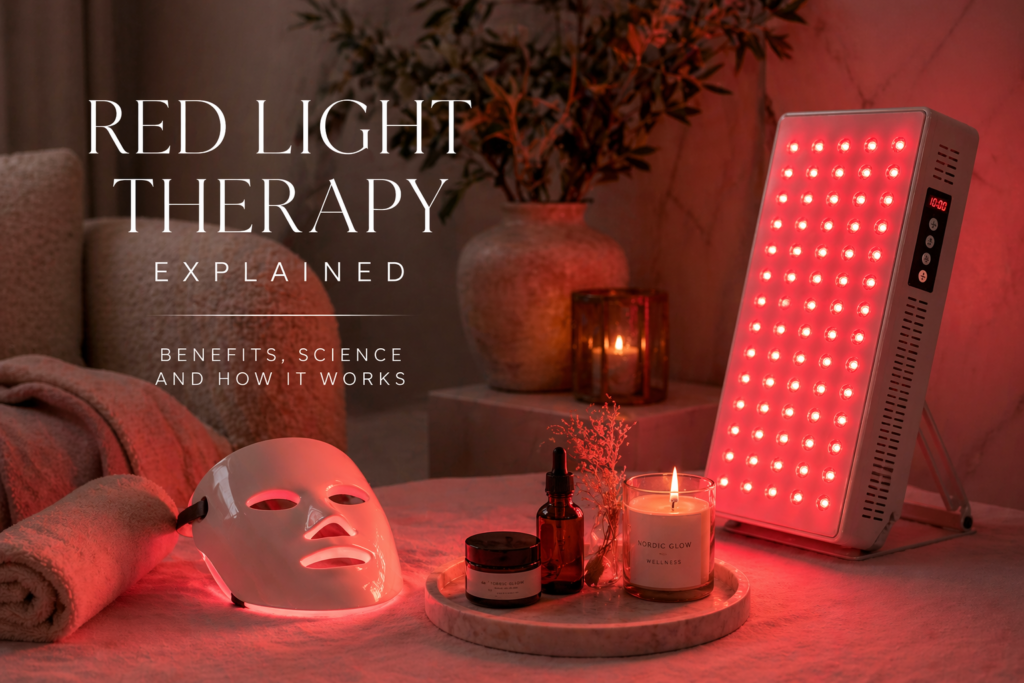
Red light therapy has become increasingly popular in the world of wellness, skincare and recovery.
From LED masks to full-body panels and infrared saunas, more and more people are turning to light-based therapies to support skin, energy and overall health.
But what actually is red light therapy — and how does it work?
What is red light therapy?
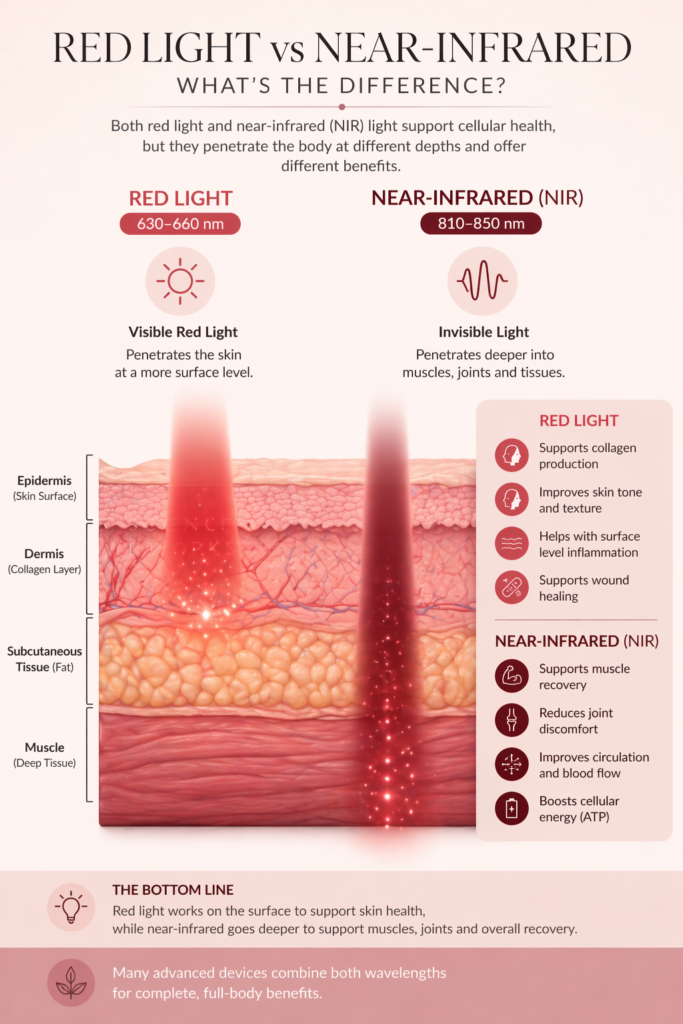
Red light therapy uses specific wavelengths of light — typically around 630–660 nm — to interact with the body at a cellular level.
Unlike UV light, which can damage the skin, red light is considered non-invasive and works by penetrating the upper layers of the skin.
There is also near-infrared light (NIR), usually around 810–850 nm, which penetrates deeper into tissue.
Together, these wavelengths are often used to support different processes in the body.
How does it work in the body?
Inside our cells, we have structures called mitochondria — often referred to as the body’s energy producers.
Red and near-infrared light are believed to interact with these mitochondria, helping them produce energy more efficiently.
This process is often linked to:
• improved cellular energy
• reduced oxidative stress
• support for repair and regeneration
In simple terms, light may help create conditions where the body can function more optimally.
Benefits of red light therapy
Red light therapy is studied and used for several different purposes:
✨ Skin & anti-aging
– supports collagen production
– improves skin tone and texture
– may reduce fine lines
🔥 Inflammation & recovery
– supports muscle recovery
– may reduce inflammation
– used in sports and rehabilitation
⚡ Energy & overall wellbeing
– supports cellular energy
– may improve recovery from fatigue
– linked to mitochondrial function
Red light vs near-infrared — what’s the difference?
You’ve already touched on this in your previous post, but a short recap works well:
- Red light → more surface level (skin, collagen)
- Near-infrared → deeper penetration (muscles, joints)
Most modern devices combine both.
Different types of red light devices
This is where your future affiliate content comes in naturally.
LED face masks
Used mainly for skin and facial treatments.
Red light panels
Used for larger areas or full-body exposure.
Infrared saunas
Combine heat and infrared light for full-body wellness.
Each has a slightly different purpose, depending on what you want to support.
My perspective
Personally, I became interested in red light therapy through the idea of supporting the body rather than forcing it.
The idea that light — something so fundamental — can influence how our cells produce energy and repair themselves is fascinating.
Especially in a lifestyle where recovery is not always optimal.
Working across time zones, dealing with irregular sleep and constant stimulation, I’ve become more aware of how important it is to support the body in small, consistent ways.
Looking ahead
In the next articles, I’ll go deeper into specific tools — including LED masks, panels and infrared saunas — and how to choose the right one depending on your needs.