
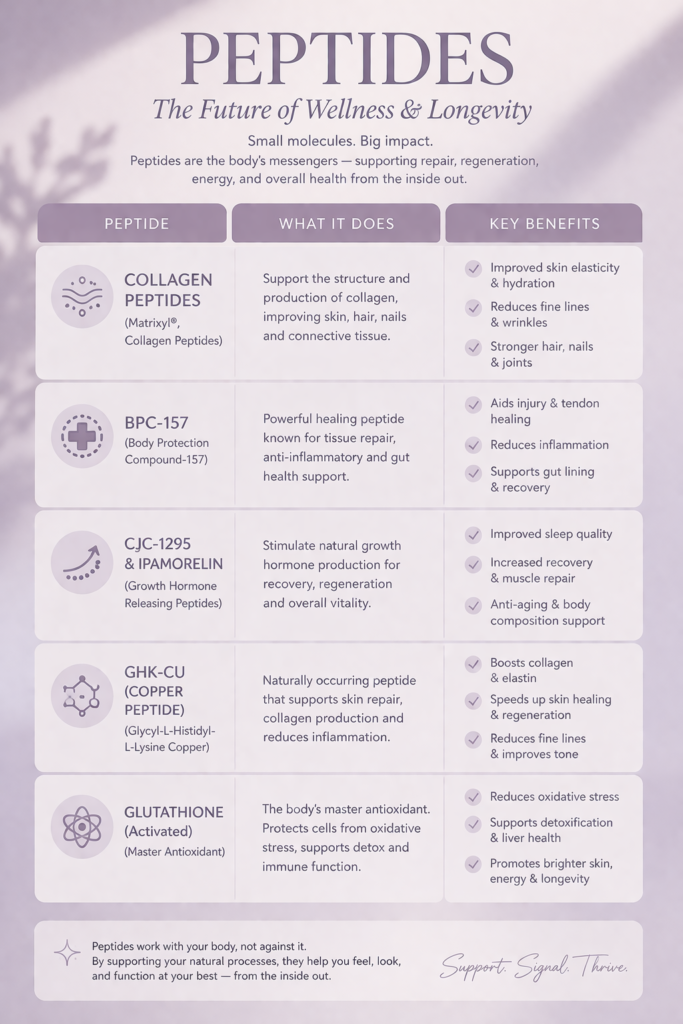
Copper peptides have become increasingly popular in the world of skincare and regenerative medicine. You’ll find them in high-end serums, anti-aging treatments, and increasingly in conversations about longevity and cellular repair.
But what exactly are copper peptides, and why are so many researchers and skincare experts interested in them?
To understand that, we need to start with what peptides actually do in the body.
Peptides are short chains of amino acids that act as signaling molecules. They help the body communicate internally — telling cells when to repair tissue, produce collagen, reduce inflammation, or regenerate damaged areas.
Copper peptides are a specific type of peptide that bind with copper ions. The most studied one is GHK-Cu, a naturally occurring peptide that exists in our blood, saliva, and urine.
In other words, this is not something foreign to the body. It’s something we naturally produce.
What do copper peptides do in the body?
Researchers have found that copper peptides play a role in several important biological processes connected to healing and aging.
Some of the most studied effects include:
• stimulating collagen and elastin production
• supporting wound healing and tissue repair
• reducing inflammation
• helping the body remove damaged proteins
• supporting skin regeneration and thickness
Because of this, copper peptides have become especially interesting in dermatology and regenerative medicine.
Many skincare formulations now include them because they appear to support the skin’s natural ability to repair itself.
Why do levels decline with age?
One reason copper peptides are discussed in anti-aging research is that natural levels of GHK-Cu appear to decline as we get older.
When we are young, the body is incredibly efficient at repairing tissue and regenerating skin. Cuts heal faster, inflammation resolves more quickly, and collagen production is much higher.
Over time, many of these regenerative signals become weaker.
This doesn’t mean the body loses its ability to repair itself — but the signals that initiate those processes may become less active.
That’s why scientists have become interested in ways to support or stimulate these natural pathways again.
Copper peptides in skincare and wellness
Today, copper peptides are used in several ways.
In skincare, they are often included in serums and creams designed to support collagen production and improve skin texture.
In research settings, they have also been studied for their potential role in wound healing, tissue regeneration, and anti-inflammatory processes.
What makes them particularly interesting is that they don’t simply add something artificial to the body. Instead, they appear to act as signals that encourage the body to activate its own repair systems.
And that idea — supporting the body’s own regenerative intelligence — is something I personally find very compelling.
A broader perspective on regeneration
When we talk about peptides, copper peptides, or antioxidants like glutathione, we’re really talking about the same underlying principle: communication inside the body.
Cells constantly send signals to each other about when to repair, when to regenerate, and when to calm inflammation.
Modern lifestyle, chronic stress, toxins, poor sleep and lack of recovery can disrupt many of these signals over time.
So a lot of the current interest in peptides, light therapy, and other regenerative tools is really about restoring those communication pathways.
Not forcing the body to do something unnatural — but helping it do what it already knows how to do.
My personal interest in this space
Personally, I became interested in copper peptides after hearing about their role in skin regeneration and inflammation.
Like many people, I first encountered them through skincare products. But the more I read about the research behind them, the more fascinating they became.
They are a reminder that the body already contains incredibly advanced repair systems. Sometimes the question is simply how to support them.
And that curiosity is what led me further into exploring peptides, antioxidants, and different technologies designed to support the body’s own regenerative processes.
Looking ahead
In the next article, I’ll dive deeper into something closely connected to peptides and regeneration: stem cells and the body’s natural repair mechanisms.
Because once you understand how the body signals repair, it opens up a completely new perspective on health, recovery, and aging.
If you want access to a technology that helps the body to produce more copper peptides, hence lower inflammation och get your anti-aging ON click the link and get your patches today! I highly recommend for getting rid of pain and getting glowing skin and health from within. I started with the AEON and x39 patches. AEON really helped me calm my nervous system and that is a great start when applying new health enhancing tools so that the body can actually utilize the technology that is offered.