
What are peptides, really?
Peptides are short chains of amino acids — the same building blocks that make up proteins.
But instead of building structure, peptides act more like messengers.
They tell the body what to do.
Different peptides send different signals:
– repair tissue
– produce collagen
– reduce inflammation
– support metabolism
– improve recovery
You can think of them as instructions — small signals that help regulate how your body functions.
Why are peptides so popular right now?
Part of it is simple:
As we age, the body produces less of certain peptides.
At the same time, many of us live in ways that constantly drain the body:
– stress
– poor sleep
– nutrient-depleted food
– environmental toxins
So even if the body has the blueprint — it’s not always getting the conditions it needs.
That’s where peptide therapy comes in.
Popular peptides right now
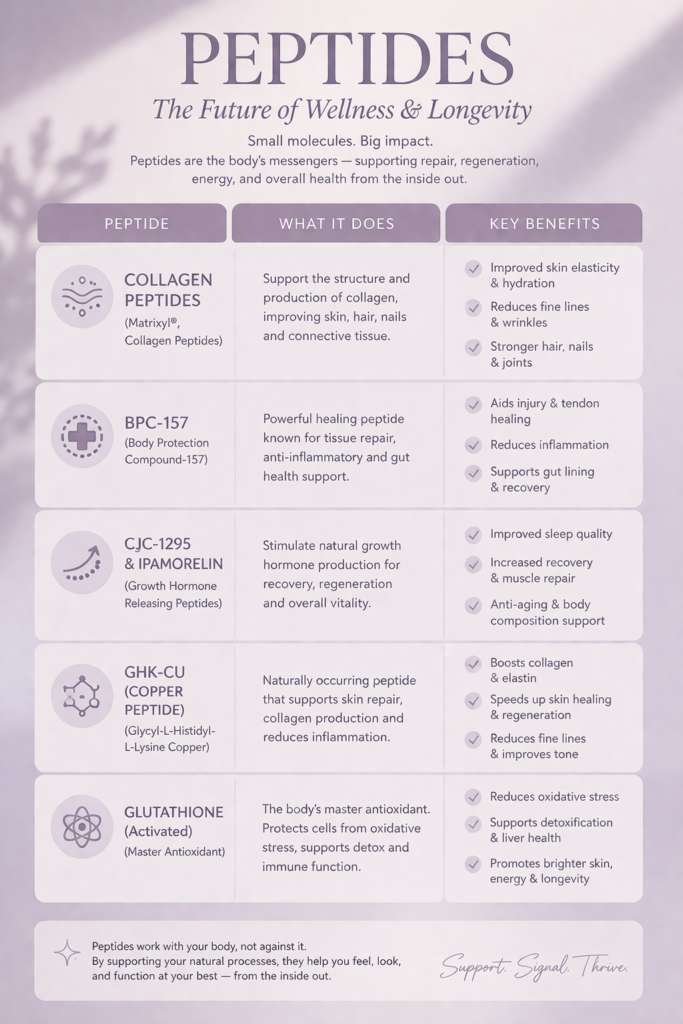
Some of the most talked-about peptides today include:
✨ Collagen peptides (in skincare & supplements)
– support skin elasticity
– improve hydration and glow
🧬 BPC-157
– often used for healing and recovery
– associated with gut health and tissue repair
💉 CJC-1295 / Ipamorelin
– linked to growth hormone release
– used for recovery, sleep and anti-aging
🔥 GHK-Cu (Copper Peptides)
– one of the most interesting ones
– supports skin regeneration, collagen, and healing
– also studied for anti-inflammatory and regenerative effects
✨ GSH Glutathione
– often called the body’s “master antioxidant”
– helps reduce oxidative stress and protect cells
– supports detoxification and liver function
– associated with brighter skin, energy and overall resilience
How do peptides actually work in the body?
Peptides don’t just “add” something — they signal.
They bind to receptors on cells and tell them to:
– activate repair
– produce collagen
– reduce inflammation
– regenerate tissue
Some peptides even influence how other systems behave:
– immune response
– oxidative stress
– cellular communication
So yes — it’s not just one isolated effect.
It’s more like a chain reaction inside the body.
But here’s what I keep thinking about
If peptides are signals…
👉 what happens when the body stops responding to them properly?
👉 or stops producing enough of them?
Is the solution always to add more?
Or is it sometimes about restoring the environment where the body can do it itself?
Why not just food, lifestyle or supplements?
In theory — we can support peptide production naturally:
– strength training
– quality sleep
– balanced blood sugar
– anti-inflammatory nutrition
But in reality?
Most of us are:
– overstimulated
– under-recovered
– slightly inflamed all the time
So even if the body can produce what it needs —
it might not always be doing it efficiently.
A different approach
This is where I’ve personally become curious.
Instead of adding substances into the body —
what if you could stimulate the body to produce its own signals again?
To support what’s already there.
Not override it.
Alternative
There are technologies that aim to do exactly this.
Using light and frequency — not chemicals —
to signal the body and potentially support its own regenerative processes.
I’ve been exploring this myself recently, especially in relation to copper peptides and recovery.
And I’ll go deeper into that in another post.
My perspective
I don’t think this is black and white. Peptides are fascinating.
The results people talk about are real. But I also believe this:
The closer we work with the body —
instead of constantly trying to outsmart it —
the more sustainable the results tend to be.
I’ll be honest — I had heard so many positive stories before trying this myself, everything from improved skin to even people talking about better heart health after previous issues, which of course are personal experiences and not something I can claim as fact, but it made me curious enough to try LifeWave patches for myself. As a flight attendant, I’m used to feeling almost constantly fatigued, like a low-level jet lag that never really leaves, but after using them consistently I noticed a real shift. That heavy, grey, drained feeling started to lift, and I felt more motivated, more energized, and more like myself again. I’m still human, I still get tired, but it feels like my baseline has improved in a way that actually impacts my everyday life. For me, that kind of support — especially when it comes to energy, recovery and inflammation — is incredibly valuable. If you are curious about anti-aging and reducing inflammation in a more non-invasive way, this is something I personally find worth exploring.
Email me or write in the comments if you would like to know more.