What’s the Difference — and What Should You Actually Choose?
Everybody seem to be using a red light device in one way or another. You see the panels, the masks, the sunas etc. This post is for you to determine and navigate your own need and also look into some products and brands that are reliable.
If you’ve ever looked into light therapy, you’ve probably come across terms like red light, near infrared (NIR), and LED — and felt slightly confused.
They are often used interchangeably, which makes it difficult to understand what you actually need.
But once you understand one simple thing, everything becomes much clearer:
👉 It’s not about which one is “better” — it’s about how deep the light goes and what you want to support in your body.
The Simple Explanation (This Changes Everything)
Let’s break it down in the easiest way possible:
- LED = the technology (how the light is produced)
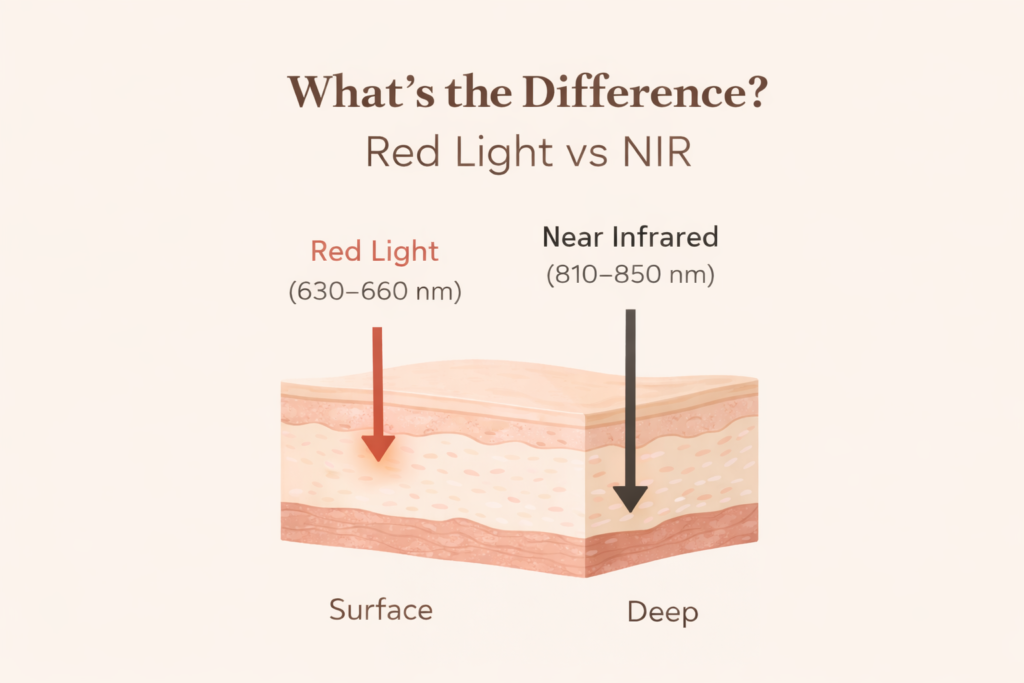
- Red light = visible light that works more on the skin surface
- Near Infrared (NIR) = invisible light that reaches deeper into the body
Think of it like this:
LED = the lamp
Red & NIR = the type of light coming from it
Many devices actually use both red light and NIR together.
What Red Light Does (Your Glow Layer)
Red light typically works in the upper and mid layers of the skin, where collagen and skin cells are most active.
It is commonly used for:
- improving skin tone
- boosting collagen
- reducing fine lines
- calming redness
- giving that “glow”
This is exactly what you’re experiencing with your LED mask —
that smoother, more even, radiant skin.
What Near Infrared (NIR) Does (The Deep Layer)
Near infrared light goes deeper — into:
- connective tissue
- muscles
- joints
- deeper layers of skin
It’s often associated with:
- recovery
- reduced inflammation
- improved circulation
- deeper tissue repair
This explains why you’re noticing:
👉 less pain in your knees and back
👉 a deeper, body-level effect from your sauna
Because NIR doesn’t just “sit on the surface” — it works underneath.
So What Does LED Actually Mean?
This is where most people get confused.
LED is not a treatment — it’s just the delivery system.
Your LED mask:
- uses LED technology
- but emits different wavelengths:
- red
- blue (acne)
- green, yellow, etc.
- NIR
So when people say “LED therapy”, they actually mean:
“light therapy using different wavelengths.”
Red Light vs NIR — What Should You Choose?
Here’s the simplest way to think about it:
Choose Red Light if you want:
- skin glow
- anti-aging
- even skin tone
- surface-level healing
Choose NIR if you want:
- pain relief
- muscle recovery
- joint support
- deeper healing
Best option?
Combination (Red + NIR)
Because:
- Red works on the surface
- NIR works deeper
Together → a layered effect in the body
🧖♀️ Where Infrared Saunas Fit In
Infrared saunas (like the one you’re using) are slightly different.
They mainly provide:
- heat + infrared light (often NIR or far infrared)
- full-body exposure
- sweating & relaxation
Your experience makes perfect sense:
- detox feeling
- reduced pain
- deeper relaxation
But:
👉 They don’t always give the same targeted skin benefits as red light devices.
🌿 My Personal Experience
I use both.
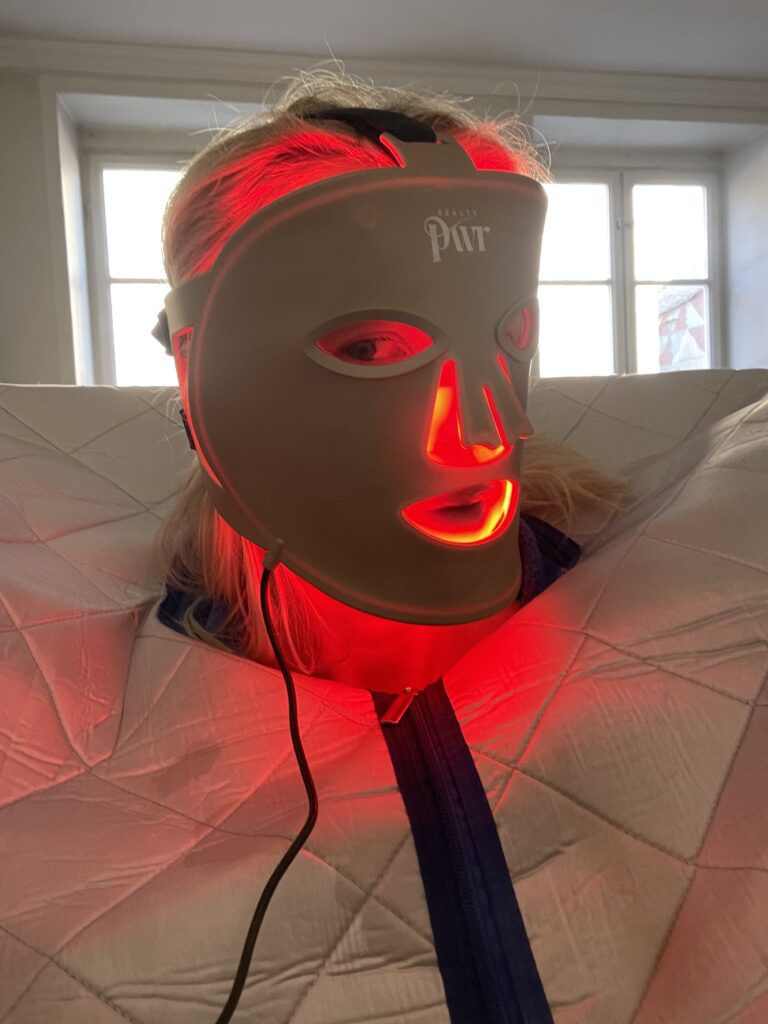
My LED mask (with red + NIR + other colors):
- gives my skin a visible glow
- makes it more even
- feels like a gentle, consistent support
I use it at least 5 days a week, and consistency really seems to matter.
At the same time, I also use a portable infrared sauna:
- especially when I want to reset
- support detox
- and reduce pain
I’ve noticed less discomfort in my knees and back, and a deeper sense of recovery.
The sauna I use doesn’t include red light — only heat and infrared —
which is why I’m currently drawn to adding a panel as well.
Because intuitively, it feels like:
- mask → skin
- sauna → whole body
- panel → something in between
✨ A Gentle Way to Approach Light Therapy
It’s easy to feel like you need everything at once.
But you don’t.
What I’ve learned is:
- consistency matters more than intensity
- simple routines work best
- the body responds to support, not force
Start with what feels natural to you:
- a mask
- a sauna
- or eventually a panel
And build from there.
When people talk about red light and near infrared, they are actually referring to different wavelengths of light — measured in nanometers (nm).
You don’t need to remember exact numbers, but having a simple overview helps you make better choices.
🔴 Red Light (Visible)
- Typically: 630–700 nm
- Most common: 630 nm / 660 nm
This is the light you can see — and it mainly works on the skin level.
✨ Best for:
- skin glow
- collagen support
- fine lines
- overall skin tone
🌑 Near Infrared (NIR)
- Typically: 700–1100 nm
- Most common: 810 nm / 830 nm / 850 nm
This light is invisible to the eye but goes deeper into the body.
🔥 Best for:
- muscles & joints
- recovery
- inflammation support
- deeper cellular energy
💡 What About LED Masks with Multiple Colors?
Many LED masks include additional wavelengths:
- 🔵 Blue light (~415 nm) → often used for acne
- 🟢 Green light (~525 nm) → pigmentation & calming
- 🟡 Yellow light (~590 nm) → redness & circulation
- 🟣 Purple light → usually a combination of red + blue
👉 These can be helpful —
but red light and NIR are the most studied and most impactful overall.
🌿 What This Means in Practice
You don’t need to overcomplicate it.
A good device will often include:
- 660 nm (red light) for skin
- 850 nm (NIR) for deeper support
👉 That combination is what many people look for when they want both beauty + recovery benefits.
🌙 Final Thoughts
Light therapy isn’t about choosing the “perfect device.”
It’s about understanding your body:
- Do you want glow?
- Do you need recovery?
- Or both?
Because once you understand the difference between red light and NIR,
everything becomes much simpler. I love my mask. I try to use it 15 min daily with red light and NIR at the same time. I think my skin looks great despite a lot of traveling. Then I try to use my portable IR Sauna a few times a week. It´s not very beautiful but its convenient. I still dream of the day I have a wooden one installed in my house. I sit in it for about 20 min or more if I have the time. But 20 min and the mask on at the same time to be efficient. I have less pain in my knees and I love just sweating out toxins.